Bacterial Cell Construction Microbiology
3. Bacteria mics. Bacteria. F-pilie. Bacteria cage. Glickocalix.
4. Bacterium cell wall. Functions of the cell wall. Construction of a bacteria cage wall. Peptidoglican. Murean bag. Peptidolkin structure (murein)
5. Graphic bacteria. Bacterium cell wall. Cellular bacteria construction.
6. The grumpy bacteria. The cell wall of the grumpy bacteria. Construction of a cell wall of grumpy bacteria. Autolysis bacteria. Spheroplasts. Protoplastics.
7. Cytoplastic membrane (BPM ) bacteria. Bacteria cytoplastic membrane. Transport systems. Mesomas. Periplastic space.
8. Cytoplastic bacteria. Bacterial genome. Bacterial ryos. Spare granules of bacteria.
9. Bacteria physiology. Bacteria. Bacteria type. Golosoes. Gold. Water. Water for bacteria.
10. Refrigerated bacterial cell connection. Ways to get the substances into a bacterial cell. Passive transfer. Diffusion.
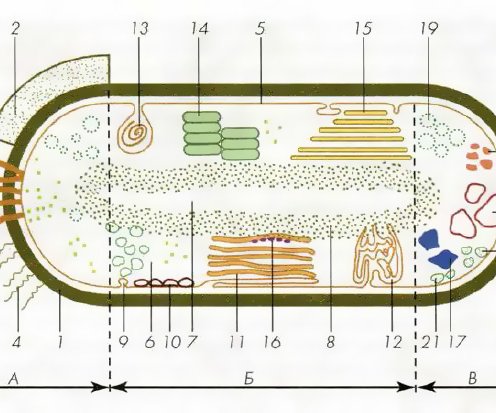
One of the main features Procariot cell - Lack of internal separation from elementary membranes. In fact, the only membrane of the procariot cell system - the CPM, which is part of the cellular casing, is often complicated and penetrates deep into the cytoplasm. In any stable bacterial cell, conditional compartments are made, superficial structures, cellular shell and cytoplastic.
Bacteria superficial structures
Main surface surfaces Bacterial cell structure ♪ capsules, gigs and microbes. Their presence is a relatively stable sign used to identify bacteria.
Bacteria Capsula
The cells of many bacteria surround a layer of immorphine, highly drained substance. This cover performs important functions: makes the cage (comprising the cell wall and the CPM) tighter and stronger, protects the bacteria against the effects of bacteritic factors, ensures adhesion on different substrates, can contain nutrient stocks.
Bacterium capsule. The CPM plays a key role in the organization of the bacteria capsule. Microcapsules are provided (expressed only with electronic microscopes in the form of a layer of mucopolisaharid microfibrill) and macropsules (detected in light microscopes). Some bacteria polymers of the cellular casing outside are freely located around it, forming a slimy layer. Capsulted bacteria can be transformed into non-campusulous options and, as the former form flourish or smooth (S) and non-campusulative colonies, this phenomenon is known as S- and R-dissociation. The capsules and sliding layer do not prevent the entry and exit of various substances from the bacterial cell, and the painters are poorly held.
Bacterium capsule. To facilitate the microscoping of the capsules, it may be possible to be visible by negatively painting the smear on Burri Guins or Hisse, or by reacting to the Noifeld flood (see below).


